
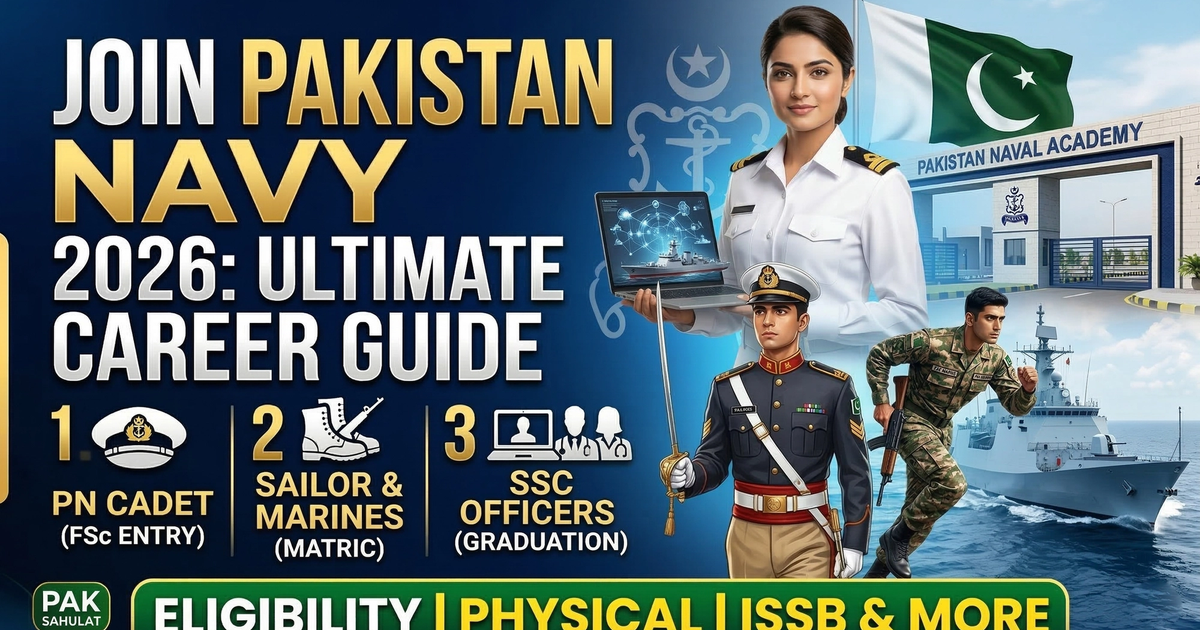
Important Update: The Pakistan Navy conducts multiple recruitment drives throughout the year. Keep a close watch on our Armed Forces Jobs Hub to get instant alerts the moment new registrations for PN Cadet, Sailors, or SSC courses open in 2026.
The Pakistan Navy, historically revered as the "Silent Force," is the absolute vanguard of Pakistan’s 1,000+ kilometer coastline and the protector of critical global maritime trade routes in the Arabian Sea. But the modern Navy is no longer just about commanding warships and submarines; it is a highly technical, multi-dimensional force offering elite careers in aerospace, artificial intelligence, cyber security, advanced marine engineering, and medicine.
Whether you have just completed your Matriculation, are waiting for your FSc results, or hold a university degree, the Pakistan Navy has a specific induction track designed for your educational level. In this definitive 2026 master guide, we will break down exactly how you can secure a prestigious commission or enlistment in the Pakistan Navy.
The 3 Major Induction Routes into the Pakistan Navy
The Armed Forces categorize inductions strictly based on academic qualifications. Attempting to apply for the wrong category is the most common reason for early rejection. Below is the overarching blueprint of the three primary pathways.
| Entry Route | Required Education | Target Audience | Starting Rank |
|---|---|---|---|
| Sailors / Marines | Matriculation (Science) | Ages 16 to 21 | Ordinary Rate / Marine |
| PN Cadet (PC) | FSc / A-Levels (Pre-Eng/ICS) | Ages 16.5 to 21 | Midshipman / Sub-Lieutenant |
| SSC Officers | 16-Years Graduation (BS/MA) | Ages 22 to 27+ | Ag Sub-Lieutenant |
(Tip: Age calculations are calculated up to the exact day the specific course begins. Use our precise Age Calculator Tool to verify your eligibility down to the day).
1. Joining After Matriculation (Sailors & Marines)
If you have completed your Matriculation with Science, you can step directly into the enlisted ranks. Inductions typically occur twice a year (classified as Batch A and Batch B). This is a phenomenal route for young men who want to start their careers early and gain highly technical, hands-on skills.
- Eligibility: Unmarried males with Matric Science (minimum 60% aggregate).
- Branches: Sailors are sorted into specialized branches based on merit and aptitude. These include the elite Pak Marines (the Navy's amphibious infantry), Technical Branches, Aviation, Naval Police, and Chef/Steward branches.
- Further Reading: Dive into the exact syllabus and physical standards in our dedicated Pakistan Navy Sailor Jobs Guide.
2. Joining After Intermediate (PN Cadet - Permanent Commission)
The PN Cadet course is the Navy’s most prestigious entry route, serving as the direct equivalent to the Pakistan Army’s PMA Long Course. Young men selected through this route are granted a Permanent Commission (PC), meaning they are destined for long-term career progression, potentially up to the rank of Admiral.
- Eligibility: Unmarried males holding an FSc (Pre-Engineering, ICS, or A-Levels) with Physics, Maths, and Chemistry/Computer Science, securing a minimum of 60% marks.
- Training: After clearing ISSB, cadets undergo rigorous military and academic training at the Pakistan Naval Academy (PNS Rahbar) in Karachi, eventually graduating with a fully-funded BS degree from Bahria University.
- Further Reading: Learn how to ace the entrance exam in our PN Cadet Eligibility & Syllabus Guide.
3. Joining After Graduation (Short Service Commission)
For university graduates holding a 16-year degree (such as a BS, BE, MBBS, or MBA), the Navy offers direct entry as an officer via the Short Service Commission (SSC). Officers serve an initial contract of 5 years, which is routinely converted into a Permanent Commission based on performance and willingness to serve.
- Eligibility: Minimum 2.5 CGPA or 60% marks from an HEC-recognized university.
- Branches: This highly diverse route is open for Information Technology (IT), Marine Engineering, Supply, Public Relations, Education, and Medical Specialists.
- Further Reading: We have analyzed the exact degree requirements for the upcoming batch in our Pak Navy SSC 2026 Guide.

Opportunities for Females in the Pakistan Navy
Unlike the Sailor or PN Cadet routes, which are exclusively for males, the Short Service Commission (SSC) actively recruits female professionals. Women with 16 years of education can join the Navy as Commissioned Officers in branches such as Information Technology, Public Relations, Education, and the Medical Branch (as General Duty Medical Officers or Specialists).
For a complete breakdown of age limits, height requirements, and medical specializations available to women, read our exhaustive guide on How Females Can Join the Pakistan Navy.
The Step-by-Step Selection Pipeline (2026 Updated)
The Navy’s selection process is unforgiving, designed to test intellectual acuity, physical endurance, and psychological resilience. Regardless of which path you choose, you will generally face this pipeline:
Phase 1: Initial E-Testing (Computer-Based)
Conducted at your local Pakistan Navy Recruitment & Selection Centre (PNR&SC), this computerized exam filters out the majority of candidates.
- Intelligence Test: Comprises Verbal and Non-Verbal reasoning questions under severe time pressure.
- Academic Test: MCQs based on your educational background (e.g., Physics, Maths, and English for PN Cadets; degree-specific questions for SSC candidates).
Phase 2: Preliminary Medical & Physical Screening
Candidates who pass the E-Test must immediately clear a baseline medical check (vision, height, weight, deformities) and a demanding physical fitness test (PET). The standard physical test includes:
- 1.6 KM (1 Mile) Run: Must be completed in exactly 8 minutes and 30 seconds.
- Push-ups: 10 repetitions in 2 minutes.
- Sit-ups: 10 repetitions in 2 minutes.
- Chin-ups: 2 strict repetitions in 2 minutes.
Phase 3: ISSB & Final Medical Board
For Officer ranks (PN Cadet and non-medical SSC), candidates must pass the rigorous 4-day Inter Services Selection Board (ISSB) test. This involves psychological testing, group tasks, and high-pressure interviews. To ensure you don't fail this critical stage, study our comprehensive guide on How to Pass the ISSB Test (Tips & Syllabus).
Finally, recommended candidates undergo a highly detailed final medical board at a Combined Military Hospital (CMH) or PNS Shifa.


